
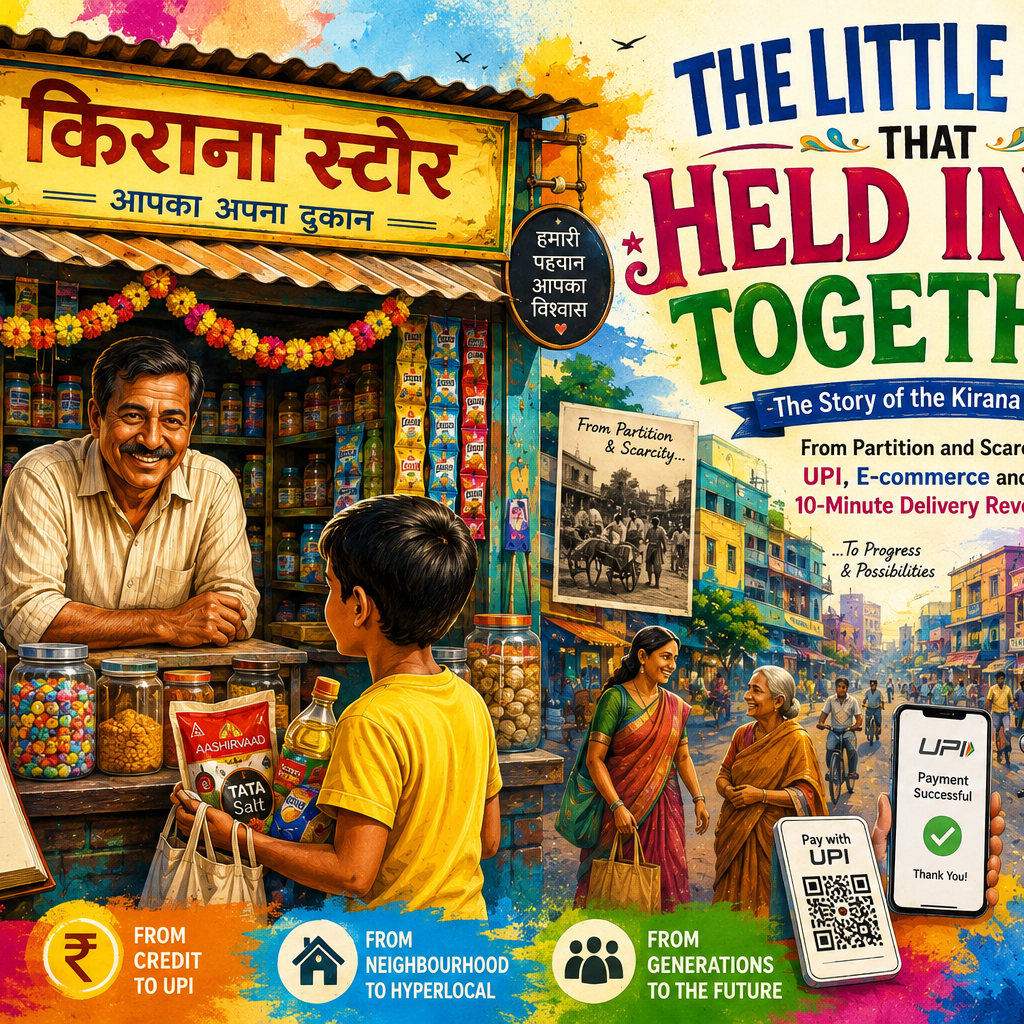
The story of the Kirana Store — from Partition and scarcity to UPI, e-commerce and the ten-minute delivery revolution
There is a particular sound that belongs to almost every Indian neighbourhood.
The scrape of a metal shutter being pulled up before sunrise. The clink of glass jars being wiped clean. The rustle of jute sacks filled with rice and dal. The weighing scale being placed on the counter. Packets of shampoo hanging from a nail like tiny silver flags.
And behind it all, a familiar face.
For generations, before India had supermarkets, shopping malls, digital wallets, e-commerce apps or ten-minute deliveries, there was a little shop at the corner of the street.
Kirana store ki Dukan. Or, as many of us still call it, Parchun ki Dukan.
Today, we often describe it with a rather dismissive phrase: “Unorganised retail.”
Technically, perhaps. But socially, economically and emotionally, that description misses almost everything that mattered.
Because the kirana store was never merely a place where goods were sold. It was a neighbourhood institution. It was India’s informal bank. Its emergency pantry. Its local information centre. Its first entrepreneurship school. Its last-mile supply chain.
And, in ways we rarely acknowledge, one of the quiet pieces of infrastructure through which ordinary Indians survived difficult times and built ordinary lives.
The history of the kirana store is, in many ways, a history of India itself.
Before Retail Became an Industry, Kirana store Was a Relationship
For generations, Indians did not shop the way we shop today. There were no monthly Amazon carts. No supermarket aisles. No loyalty programmes. No credit cards. No UPI. And certainly no notification saying: “Your order will arrive in 10 minutes.”
A family bought what it needed, when it could afford it. Half a kilo of rice. 250 grams of dal. ₹10 worth of sugar. Two biscuits. One bar of soap. A litre of oil. Sometimes just one egg. Sometimes just one sachet.
The shopkeeper understood. He knew that ₹500 meant something very different to different families. He knew who got paid on the first of the month. Who was waiting for a salary. Whose child had started school. Whose daughter was getting married. Who had a medical expense. Who was having a difficult month.
And sometimes, when the money simply wasn’t there, came the sentence that no algorithm has ever quite managed to reproduce:
“Le jao. Paise baad mein de dena.”
Take it. Pay later.
That wasn’t merely a transaction. It was trust converted into economic infrastructure.
The handwritten udhaar ki bahi, or khata, was an informal credit system built not on collateral, credit scores or algorithms—but on reputation. A name. A date. An amount. And the belief that the person would eventually return.
The kirana store did not need to know your credit score. It knew you.
When India Was Being Built, the Kirana store Was There
To understand the importance of the kirana store, we must remember the India in which it grew. An India emerging from colonial rule. An India dealing with poverty, shortages and rationing. An India where supply chains were nothing like the sophisticated networks we take for granted today.
And then came Partition.
Millions were uprooted. Families crossed borders carrying whatever they could. Cities and towns suddenly had to absorb enormous numbers of refugees. Food and essential commodities were not merely commercial products anymore. They were matters of survival.
In that India, the neighbourhood shop mattered. Not because it was technologically advanced. It wasn’t. Not because it had sophisticated logistics. It didn’t.
It mattered because it was there. Within walking distance. Open when needed. Selling in quantities people could actually afford. Knowing the neighbourhood. Extending credit when necessary. Making a limited household income stretch a little further.
The formal systems of the new nation were still being built. The kirana store was already functioning.
There are countless family stories from those years of shopkeepers extending credit, forgiving debts or helping families who had lost almost everything. The documentation may not always have captured these acts. But communities remembered. And sometimes history survives not in government files, but in the stories families tell their children.
The little shop on the corner became one of the first signs that a neighbourhood was becoming a neighbourhood again.
The Silent Backbone of the Indian Middle Class
There is another story we rarely tell. The story of India’s middle class.
The Indian middle class did not suddenly appear with liberalisation, IT companies, corporate salaries or real estate booms. It evolved slowly. And the kirana store evolved alongside it.
The economics of the kirana store were perfectly aligned with the economics of ordinary Indian households. A family didn’t necessarily need to buy 25 kilograms of rice. It could buy two. It didn’t need an entire carton. It could buy one. It didn’t need to pay immediately. It could settle the account later.
This flexibility was extraordinarily important. The kirana store understood salary cycles. Festival spending. School fees. Weddings. Medical emergencies. Bad months. Good months. The unpredictable economics of Indian family life.
In fact, the shopkeeper often understood the household budget better than a spreadsheet ever could.
A family could buy ₹20 today and return tomorrow. The shop could sell a single shampoo sachet. One biscuit packet. One egg. A handful of spices. A litre of oil.
The modern retail industry would later call this micro-purchasing. The kirana store simply called it business.
And that business model created livelihoods for millions. For countless families, opening a small grocery shop was one of the first accessible forms of entrepreneurship. No venture capital. No business school. No pitch deck. No valuation. Sometimes just a small room, a supplier willing to extend inventory credit, a weighing scale and the willingness to work from morning until night.
It Was Never Just About Groceries
Ask an older Indian about the kirana store of their childhood. They probably won’t begin by telling you about brands. They will remember the person.
The shopkeeper who knew their name. The uncle who gave them a toffee. The counter where their mother handed them a handwritten list. The shop where someone said: “Beta, tumhare papa ka account hai.”
The shopkeeper who knew when an elderly neighbour hadn’t come for several days. The person who delivered groceries without charging a delivery fee. The person who quietly allowed a family to buy now and pay later.
That was an invisible form of social infrastructure. No app measured it. No investor valued it. No quarterly report included it. But it worked. And it worked for generations.
Then India Changed
Then came the 1991 economic liberalisation. It changed India’s economic trajectory. New businesses arrived. New brands arrived. Organised retail expanded. Supermarkets arrived. Hypermarkets arrived. Shopping malls appeared.
Large retail chains brought better displays, more SKUs, air-conditioning, professional billing, promotions and sophisticated supply chains. The little shop had almost none of these.
So the question became inevitable: Would the kirana store survive?
It did. Because the supermarket could offer variety. The kirana store offered something much harder to manufacture. Trust.
Then Came the Internet
And this time, the threat looked different. E-commerce didn’t simply build bigger stores. It tried to make the physical store unnecessary.
Why walk to the corner? Open an app. Why remember what you need? The app remembers. Why compare prices? The algorithm does it. Why carry the bag? Someone delivers it.
Suddenly, the kirana store was no longer competing with another retailer. It was competing with technology. With logistics. With data. With algorithms. And with enormous pools of investment capital.
But groceries remained one of the most difficult categories to completely digitise because people buy them differently. They buy frequently. They buy urgently. They buy small quantities. They want fresh produce. They forget things. They need things unexpectedly.
And then came the technology that understood exactly where the kirana store’s greatest advantage lay. Speed.
The Ten-Minute Revolution
Quick commerce changed the definition of convenience. Dark stores. Hyperlocal fulfilment. Real-time inventory. Demand forecasting. AI. Delivery fleets. Personalised recommendations. Investor-funded discounts. And the promise that something you needed could reach your doorstep in minutes.
For decades, the kirana store had quietly promised: “I’ll get it to you.” Quick commerce transformed that into: “I’ll get it to you in ten minutes.”
And suddenly, the little shop that had served the same neighbourhood for thirty years was being told: You are too slow.
But perhaps that diagnosis was wrong. The kirana store wasn’t slow. It was operating under a completely different economic system.
The platform could raise billions. The kirana owner had his savings. The platform could subsidise discounts. The kirana had his margin. The platform could hire engineers. The kirana had his son. The platform had data. The kirana had memory. The platform had algorithms. The kirana had relationships. The platform had venture capital. The kirana had family capital.
And yet, something remarkable happened. The kirana fought back.
The Pencil Became a QR Code
The shopkeeper who once maintained an udhaar ki bahi began accepting UPI payments. The QR code appeared beside the weighing scale.
Then came WhatsApp orders. Digital billing. POS machines. Barcode scanners. Inventory software. Online ordering. Home delivery. Digital accounting.
Some stores joined digital commerce networks. Some partnered with delivery platforms. Some became mini-supermarkets. Some modernised their shelves. Some created their own WhatsApp customer lists.
The transformation wasn’t always elegant. It wasn’t always fast. But it was happening.
The same shopkeeper who once wrote your account in pencil was now checking inventory on a smartphone. The same counter that once held a calculator now held a QR code. The same neighbourhood relationship was suddenly being supported by technology.
And this may be the most important lesson in the entire story: The kirana did not survive by remaining unchanged. It survived by changing without losing what made it valuable.
The Great Irony of Modern Retail
There is something almost poetic about the retail revolution happening around us. Technology companies have spent billions trying to recreate things the kirana was already doing.
Hyperlocal delivery? The kirana did it. Personalised shopping? The kirana did it. Neighbourhood commerce? The kirana did it. Credit based on trust? The kirana did it. Understanding local demand? The kirana did it.
Knowing what a customer is likely to buy? The kirana didn’t need machine learning. He knew the family.
Today, the modern retail industry calls it: Data-driven personalisation. The kirana called it: “Mujhe pata hai aapko kya chahiye.”
That is the irony. We spent billions teaching machines to understand consumers. The kirana spent decades understanding people.
But We Should Not Romanticise the Struggle
There is a danger in turning this into a sentimental story. The kirana store is not invincible. Many are genuinely under pressure.
Consumer behaviour is changing. Younger consumers are increasingly comfortable with apps. Price comparison is instant. Organised retail continues to expand. Quick commerce is aggressive. Rental costs are rising. Margins are under pressure. Inventory is becoming more complex.
And perhaps the biggest challenge is generational. The son or daughter of a shopkeeper may not want to inherit the shop. For them, the dream may be somewhere else.
So this is not a story about a heroic little shop defeating technology. It is a story about adaptation.
And perhaps that is why the kirana has survived for so long. It understands something fundamental about India: India does not replace the old with the new. It absorbs the new into the old.
The Kirana Doesn’t Need to Defeat Technology
It needs to use it.
Imagine the kirana of tomorrow. AI-assisted purchasing. Digital inventory. Automated replenishment. UPI and digital credit. WhatsApp ordering. Local delivery. Customer loyalty programmes. Personalised offers. Digital accounting. Online discovery. Hyperlocal fulfilment. Modern merchandising. Data-driven procurement. And perhaps even AI helping a shopkeeper predict what his neighbourhood will need next week.
But behind the screen… there is still a person. Behind the QR code… there is still a relationship. Behind the inventory software… there is still a neighbourhood.
That is the opportunity. India does not necessarily need to replace millions of small retailers with millions of warehouses. It may be far more powerful to digitise the millions of relationships those retailers already possess.
The Shop at the Corner Deserves a Different Kind of Respect
We celebrate India’s unicorns. We celebrate founders. We celebrate billion-dollar valuations. We celebrate artificial intelligence. We celebrate apps that deliver groceries in ten minutes. And rightly so.
But somewhere in almost every Indian neighbourhood is a shop that may have existed before today’s technology companies were even ideas.
A shop that survived shortages. Partition’s aftermath. Economic uncertainty. Liberalisation. Supermarkets. Shopping malls. E-commerce. A pandemic. And now quick commerce.
It may not have raised venture capital. It may not have a board of directors. It may not have a mobile app. It may not have a valuation. But it possesses something extraordinarily difficult to build: decades of trust.
Perhaps We Have Been Asking the Wrong Question
For years, we asked: “Will the kirana store survive?”
Perhaps that was the wrong question. The better question is: “What will the kirana store become?”
Because India has always been a country where old and new coexist. Bullock carts and satellites. Chai stalls and fintech. Handwritten notebooks and artificial intelligence. Temples and technology parks. And now… Kirana stores and quick commerce.
The future of Indian retail may not belong entirely to the giant warehouse. It may not belong entirely to the corner shop either. It may belong to something new. Technology + proximity. Data + relationships. Speed + trust. Scale + local understanding.
And if that happens, the kirana store will once again prove something it has quietly demonstrated for generations: You don’t survive in India by being the biggest. You survive by understanding India.
One Last Thought
The next time you walk past your neighbourhood Parchun ki Dukan, don’t just see a shop.
See the history. See the family that built it. See the generations that bought from it. See the credit it extended. See the household budgets it helped stretch. See the children who grew up running errands there. See the difficult years it survived. See the competition it never asked for. See the technology it never expected. And see the person sitting behind that counter.
Because before India learned to order groceries in ten minutes… someone was already delivering them.
Before we invented customer loyalty… someone already knew the customer’s family.
Before fintech created digital credit… someone was already keeping an udhaar ki bahi.
And before algorithms learned what India wanted… the kirana shopkeeper was already listening.
The Kirana Store was never just a shop. It was one of the smallest, quietest and most enduring institutions through which ordinary Indians survived, adapted and built their lives.
And perhaps the greatest mistake modern retail can make is to assume that because the shop is small… its place in India’s story is small too.
It isn’t. It never was. And it may yet have its most important chapter ahead.