
The Risks of a Pay For Performance Sales Model
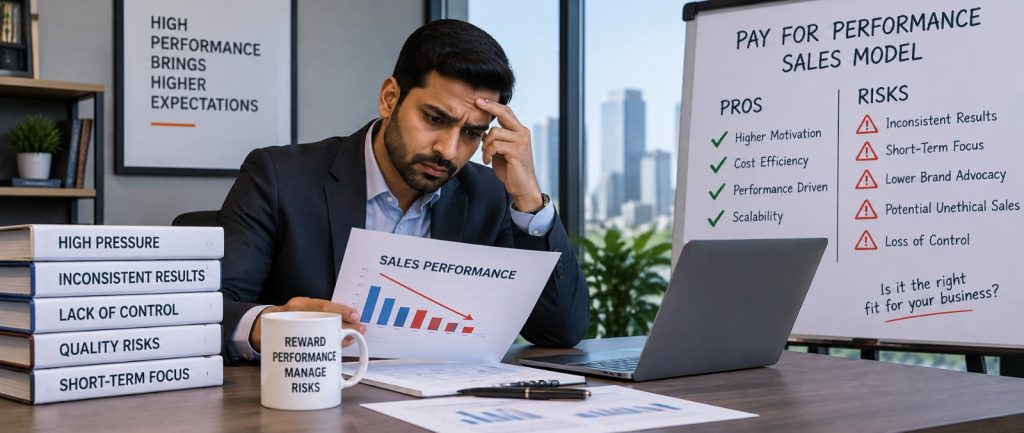
What are the risks of a Pay For Performance sales model?
As a principal B2B sales and lead generation firm, we often engage in conversations with new acquaintances that begin with the phrase, “I’ve heard from other firms like yours that they only charge when they get an appointment or a sales lead…”
This is a type of sales model we often get questions about.
However, since it seems to come up frequently at industry conferences and trade shows, it is worth revisiting why the pay per performance sales model may not support a successful sales and lead generation campaign when complex solutions, products, or services are involved.
The lower upfront expense of a pay for performance model might be enticing, but in the long term, it could be costing you a lot more.
How is your company being represented?
When you outsource to a sales and B2B lead generation firm, they are representing your brand.
Whether or not the prospect on the other end of the line is aware that the call is from an outsourced company, whoever is speaking on your behalf is representing your company directly.
If you have inexperienced, low-level salespeople or callers on the phone, there is a risk that those callers may negatively impact your brand.
Whether the prospect is interested or not, an experienced, professional, senior-level salesperson will do a better job of representing your company.
This is true whether there is a meaningful conversation or even simply a thoughtful voicemail. There is mindshare to be gained from that interaction.
With professional business development, the goal is to engage in a meaningful interaction no matter what the outcome. Simply put, it matters who is making the call, even if it does not lead to a next-step appointment right away.
What is the real incentive for the salesperson?
One of the issues we hear from clients who have tried the pay for performance or pay per lead model is that the leads they receive are not fully qualified.
If the caller is compensated for getting a result, such as a lead or an appointment, then the pressure on the salesperson is to get that result. Certainly, if you are selling a simple commodity, this approach can work well.
But if you have a complex product, solution, or service, the result you want is professional business development resulting in qualified leads, not a list of lukewarm appointments.
If the motivation of the caller is simply to get the lead, whether that lead is qualified or not is not the primary concern, and your results will reflect that motivation.
The risk here is a tendency for the caller not to qualify a lead too far. If a caller gets paid only to perform and set appointments, then why would they fully qualify and potentially disqualify themselves from the lead instead of simply making an appointment and moving on?
Industry experience
In my role, I have had the opportunity to interview many business development executives who would like to work with us.
I ask them what their goal is when they make a sales call. If they tell me they want to “lightly qualify leads and get the appointment as soon as possible,” this tells me that they are calling an executive and trying to get them to do something — sign up for a webinar, attend an event, or agree to an appointment.
When I hear that, I know they are not right for a firm like ours that specializes in B2B lead generation for complex sales.
What we want to accomplish, and what is very different from anything you would get from a pay for performance model, is peer-to-peer communication with senior-level executives.
Our Business Development Executives (BDEs) are offering a complex product, solution, or service that is either helpful to a prospect or not.
If it is helpful, then let’s talk about it. If it is not something they are looking for, the call can still be successful because the BDE was able to speak as a peer and create a meaningful interaction.
The prospect, even though they have not made any commitment, will have had a good experience, and the brand will have been well represented. We know that is important.
The true cost of Pay For Performance
If you are only looking at the upfront cost, a pay for performance sales model may appear to be a good business decision.
But if your company sells a complex product or solution, or if you have a service that is very unique to a specific industry, then you are risking a lot by paying only for appointments.
The real value of sales development lies in the quality of conversations, the experience delivered to prospects, and the long-term impact on your brand — not simply the number of appointments generated.